




Steam sauna
Steam sauna is an imprecise name for several kinds of hot, humid bathing room. It may denote a purpose-built steam bath supplied by a steam generator, a lower-temperature warm-air room with controlled humidification, or a hybrid cabin capable of more than one climate. Because these arrangements differ in heat source, moisture regime, enclosure and controls, the label by itself does not define a technical type.
The term is also sometimes applied to a Finnish sauna after water is cast on its heated stones. That usage conceals a material difference: löyly produces a short-lived humidity pulse in a stone-heated room, whereas a generator-fed steam room maintains a humid climate as an operating condition. Technical descriptions therefore need to state the actual room class, equipment, measurement position and exposure, rather than treating every humid sauna as equivalent.
Terminology and classification
Standards illustrate why clarification is necessary. ISO 17679:2016, a service standard for wellness spas, defines a sauna as a wooden cabin with hot dry air and distinguishes it from a room or cabin with hot steam, termed a steam bath.[1] This deliberately simple service vocabulary separates facility types, but it does not describe the temporary humidity changes of Finnish practice.
-
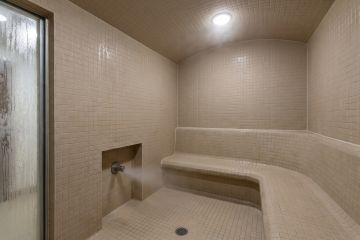 A purpose-built steam bath supplied by a generator: closed wet-room surfaces and a sustained humid climate. AI-generated illustration.
-
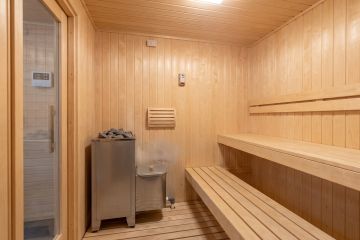 A timber cabin run as a humidified warm-air programme: a heater with an integrated reservoir and separate humidity control. AI-generated illustration.
-
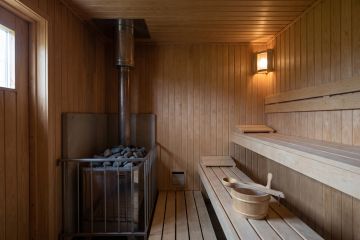 A stone-heated room after water is cast on the stones, which the term is also sometimes applied to. AI-generated illustration.


EN 18164:2026 instead specifies four classes of climated room for public use; steam sauna is not one of them. At a measuring position 1 m above the top bench, its “sauna room” class is 80–105 °C and below 10% relative humidity, except during a brief infusion. Its “steam room” class is 40–49 °C at saturation, while its “soft steam room” class is 30–70 °C below saturation.[2] These figures belong to that European construction standard, not to a worldwide legal code or a set of personal recommendations; national requirements may differ, and electrotechnical work is outside its scope.
Within sauna classification, the expression is consequently best treated as a request for more information. A room with closed, wet-area surfaces that is operated near saturation is more precisely described as a steam bath. A moderate humid programme might instead be a Bio sauna or another controlled warm-air format. Temperature, visible mist or a trade name alone cannot settle the classification.
Climate and heat transfer
Water vapour is gaseous water; the visible cloud commonly called steam consists of small liquid droplets formed when vapour condenses. Humid room air is still a mixture of gases rather than pure gaseous water. Its water-vapour content must also be distinguished from relative humidity. Absolute humidity expresses water vapour per volume, whereas relative humidity compares the actual vapour pressure with saturation pressure at the same temperature.
Those quantities respond differently when air is heated, exchanged or supplied with additional moisture. A surface at or below the dew-point temperature may collect liquid water even if the measured air temperature remains stable. Phase change also exchanges latent heat. ASHRAE treats heat, air and moisture movement through building assemblies as coupled processes involving vapour diffusion, airflow, capillary transport and liquid flow.[3] Those principles explain condensation, but do not constitute a universal steam-room specification.
A bather gains heat through convection and radiation and, where vapour condenses on cooler skin, through latent heat transfer. High water-vapour pressure also limits evaporation of sweat, restricting one route of body cooling.[4] Thermal experience therefore depends on air and surface temperatures, humidity, air movement, duration and individual condition. Saying simply that steam “raises the temperature” confuses dry-bulb temperature with moisture and heat flow.
Equipment and room fabric
A generator-fed room heats water and admits vapour through a distribution outlet; sensors and controls regulate delivery for the intended climate. A sauna heater incorporating a humidifier is a different apparatus. The current published consolidated edition 4.2 of IEC 60335-2-53 includes electric sauna heaters with humidifier units that evaporate or atomise water, alongside conventional electric heaters and infrared-emitting units, within its appliance-safety scope.[5] This does not make a humidifier-equipped heater a separate steam generator, nor does the appliance standard govern the whole room.
Repeatedly humid operation loads ceilings, walls, seats and floors with vapour and liquid water. The enclosure consequently requires moisture-tolerant, cleanable surfaces, drainage and details that manage both condensation and drying. EN 18164 offers one framework for public facilities, while Dutch public-health guidance calls for water-resistant, cleanable surfaces, drains, ventilation and repair of defects that retain water in covered wellness premises.[6] Neither source specifies one assembly for every building. Detailed waterproofing, drainage and ventilation must suit the chosen system, adjoining spaces and applicable rules.
Drying after use is part of moisture management. A WHO review supports the broad principle that persistent dampness and microbial growth should be prevented through control of moisture sources, condensation and ventilation.[7] It is general building guidance rather than a maintenance timetable for steam rooms; investigation of visible growth belongs under Mould in a sauna.
Neighbouring humid formats
A stone-heated sauna normally produces a transient water event rather than sustaining saturation. A dedicated steam bath, by contrast, supplies vapour continuously or intermittently to maintain its operating climate. Cabins that combine conventional heating with controlled humidification are more accurately identified by their selected mode or as a combination sauna. Proprietary programmes such as Sanarium likewise have specified climates and should not be used as synonyms for every steam room.
Equipment and fabric are integral to these distinctions. EN 18164 describes one sauna-room class using timber and a stone-filled heater and a steam-room class using suitable closed surfaces and heat-and-steam-generating equipment.[2] This comparison concerns the standard's defined classes; it does not establish that timber can never be used in a humid installation. Detailed component selection and control architecture belong to Sauna technology.
Physiological response and evidence limits
Small controlled studies show why a lower air temperature does not necessarily produce lower physiological strain. Pilch and colleagues studied ten healthy men aged 25–28 in a fixed-order experiment. Three dry-heat sessions were followed one month later by three humid-heat sessions. The latter, at about 59 °C and 60.5% relative humidity, produced larger changes in rectal temperature, heart rate and calculated strain, but was neither randomised nor a test of a saturated steam room.[8]
In a randomised, counterbalanced comparison, Campbell and colleagues exposed 13 physically active adults to each of four heating modes for 60 minutes on five consecutive days, with washout periods between modes. In the humid-air condition of 55 °C and 54% relative humidity, nine participants could not tolerate the full hour; core-temperature rise was nevertheless no greater than with hot-water immersion and was lower than with exercise.[9] Both studies used small selected samples and demanding research protocols. Neither establishes a clinical benefit, a universal exposure limit, detoxification, durable fat loss or treatment of disease.
Operation and safety
Hot, humid exposure can contribute to dizziness, fainting, dehydration and heat illness; hot surfaces can burn, and wet floors create a slipping hazard.[4] Controls for public premises vary. A Southend-on-Sea licensing code, for example, calls for impervious finishes, a floor laid to drain, temperature monitoring, a door with a glazed panel and internal exit handle, an alarm and daily cleaning.[10] These are local provisions, not international requirements.
Public rooms also require cleaning, water-system control and drying; operating heat does not sterilise the enclosure. A 1998 Lancet letter reported a Dutch cluster of six legionellosis cases associated with sauna and steam-bath exposure, and the later NCCEH review records that two were fatal.[11][4] This historical cluster does not estimate present-day incidence. The relevant mechanism is contaminated water and aerosol-producing equipment under favourable conditions, not water-vapour molecules themselves.
Accessibility and safe use are also jurisdiction-dependent. The United States Access Board's guidance for facilities covered by the Architectural Barriers Act addresses clear floor and turning space, benches, controls and wet-surface performance.[12] The room and its equipment must ultimately be installed and operated under the building, electrical, plumbing, accessibility and public-health requirements applying to the actual location.
References
- ↑ ISO, ISO 17679:2016, Tourism and related services — Wellness spa — Service requirements, first edition, 2016, confirmed current in 2022, https://www.iso.org/standard/60243.html, accessed 4 September 2026.
- ↑ 2.0 2.1 European Committee for Standardization, EN 18164:2026, Wellness facilities for public use — Climated rooms — Requirements, approved 26 January 2026, sections 1 and 4; official Slovak national preview, https://normy.normoff.gov.sk/norma/142477/nahlad/, and DIN Media record, https://www.dinmedia.de/en/standard/din-en-18164/399528780. doi:10.31030/3677043.
- ↑ ASHRAE, “Heat, Air, and Moisture Control in Building Assemblies—Fundamentals”, chapter 25 in 2025 ASHRAE Handbook—Fundamentals, https://handbook.ashrae.org/Handbooks/F25/IP/F25_Ch25/F25_Ch25_ip.aspx, accessed 4 September 2026.
- ↑ 4.0 4.1 4.2 Tina Chen, Rapid review: Environmental health risks and safety considerations in saunas, National Collaborating Centre for Environmental Health, 16 January 2026, https://ncceh.ca/resources/evidence-briefs/rapid-review-environmental-health-risks-and-safety-considerations-saunas, accessed 4 September 2026.
- ↑ International Electrotechnical Commission, IEC 60335-2-53:2011+AMD1:2017+AMD2:2021, Household and similar electrical appliances — Safety — Part 2-53: Particular requirements for sauna heating appliances and infrared cabins, consolidated edition 4.2, 9 March 2021, https://webstore.iec.ch/en/publication/68677, accessed 4 September 2026.
- ↑ Rijksinstituut voor Volksgezondheid en Milieu, Hygiënerichtlijn voor sauna’s, wellnesscomplexen en zwembaden, fully revised 22 May 2025, https://www.rivm.nl/hygienerichtlijnen/sauna, accessed 4 September 2026.
- ↑ WHO Regional Office for Europe, WHO Guidelines for Indoor Air Quality: Dampness and Mould, 2009. ISBN 9789289041683. https://www.who.int/publications/i/item/9789289041683.
- ↑ Wanda Pilch, Zbigniew Szyguła, Tomasz Pałka, Paweł Pilch, Tomasz Cisoń, Szczepan Wiecha and Łukasz Tota, “Comparison of physiological reactions and physiological strain in healthy men under heat stress in dry and steam heat saunas”, Biology of Sport, volume 31, issue 2, 2014, pp. 145–149. doi:10.5604/20831862.1099045.
- ↑ Holly A. Campbell, Ashley P. Akerman, Lorenz S. Kissling, Jamie R. Prout, Travis D. Gibbons, Kate N. Thomas and James D. Cotter, “Acute physiological and psychophysical responses to different modes of heat stress”, Experimental Physiology, volume 107, issue 5, 2022, pp. 429–440. doi:10.1113/EP089992.
- ↑ Southend-on-Sea City Council, Code of Practice 4: Saunas and Steam Rooms, undated current guidance, https://www.southend.gov.uk/downloads/file/5499/code-of-practice-4-sauna-and-steam-rooms, accessed 4 September 2026.
- ↑ J. W. Den Boer, E. Yzerman, A. van Belkum, F. Vlaspolder and F. J. M. van Breukelen, “Legionnaire’s disease and saunas”, The Lancet, volume 351, issue 9096, 1998, p. 114. doi:10.1016/S0140-6736(05)78145-9.
- ↑ United States Access Board, “Chapter 6: Saunas and Steam Rooms”, Guide to the ABA Accessibility Standards, September 2021, https://www.access-board.gov/aba/guides/chapter-6-saunas/, accessed 4 September 2026.