




Sauna
Sauna is a heated enclosure and a form of bathing in which people expose themselves to a controlled hot environment, usually with intervals for washing, rest or cooling. The English noun can mean either the room or a period spent in it; it entered English from Finnish in the late nineteenth century.[1] In present-day international usage, the term is broader than Finnish sauna and is applied to installations that do not all create the same climate or support the same practices.
Most conventional saunas heat the room, its surfaces and the occupants, often through a heater containing stones. Some use wood combustion and others electricity. The sauna label is also applied to infrared cabins, which direct thermal radiation from emitters towards the body while generally heating the room air less. The relevant international appliance standard covers both sauna-heating appliances and infrared-emitting units, but treats them as distinct kinds of equipment.[2] A sauna is also distinct from a bath kept continuously humid by a steam generator, although water placed on sauna stones can produce a short-lived rise in humidity.
Principle and terminology
The Sauna room limits heat loss and separates the bathing climate from adjoining spaces. Energy from the heater warms the air, the building surfaces and, where fitted, the stones. A bather receives heat by radiation and convection, as well as by conduction where the body touches a bench or other surface. Sweating provides evaporative cooling, but its effectiveness changes with air movement and moisture. Measurements from a single experimental sauna also show that timber surfaces exchange heat and moisture with the air, so neither a thermostat setting nor one air-temperature reading fully describes the exposure.[3]

There is no universal temperature, humidity or ritual that makes every installation a sauna. Sauna technology and Sauna types vary by heat source, operating method, room design and local convention. The term should therefore identify an umbrella category, not imply that infrared cabins, smoke-heated rooms and continuously humid steam baths are technically interchangeable.
Historical development
The History of the sauna does not reduce to a securely dated invention or a single lineage for every form of sweat bathing. In Finland, smoke-heated rooms were followed by several forms of flued wood-burning heater and, later, electric heating. Heaters may store heat before bathing or be fired continuously, so even this broad technological sequence contains several branches.[4]
Domestic, rural and urban histories also differ. A documented Helsinki example illustrates the danger of treating one locality as a universal model. Chimneyless huts and saunas were prohibited in Finnish towns in the 1720s because of fire risk, although the ban was not consistently obeyed. Industrialisation and population growth increased demand for public saunas in nineteenth-century Helsinki; their practical role later diminished as private bathrooms became more common.[5]
Sauna is nevertheless more than a succession of appliances: it also belongs to Sauna culture. UNESCO inscribed “Sauna culture in Finland” in 2020 on the Representative List of the Intangible Cultural Heritage of Humanity.[6] It separately inscribed the smoke-sauna tradition in Võromaa, Estonia, in 2014; that element includes bathing customs, making whisks, skills for building and repairing saunas, and smoking meat.[7] These are recognitions of two specific living traditions, not a designation of all sauna buildings or proof that all heat-bathing practices share one origin. Wider comparison belongs to Sauna around the world and Bathing culture.
Main forms and settings
In Finnish-style installations, form is often classified by the heater. A Wood-burning sauna may have a flued or chimneyless heater and may store heat for later bathing or continue burning during use. A typical Electric sauna circulates air through heating elements and stones and uses controls such as a thermostat, timer and temperature limiter.[4] The presence of stones makes it possible to evaporate added water, but stones are not part of every installation marketed as a sauna.
-
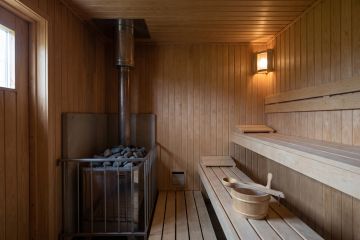 Conventional stone-heated sauna: a heater carrying stones warms the room and its surfaces, and water can be cast on the stones. AI-generated illustration.
-
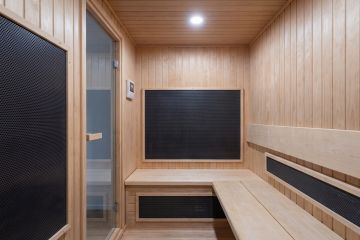 Infrared cabin: emitters direct radiant energy at the occupant, with no stone mass and normally no water. Shown from a comparable viewpoint for comparison. AI-generated illustration.


Infrared cabins use electrically powered emitters rather than a conventional room heater as the main source of heat reaching the occupant.[2] Their lower air temperatures, absence of a stone mass in many models and different balance of radiant and convective heat mean that findings from one system cannot automatically be transferred to the other. Similarly, a continuously steam-supplied bath creates a persistently wetter environment rather than the intermittent humidity typical of water cast on stones.
Setting is another useful distinction. An Indoor sauna may be private or form part of a swimming pool, gym, hotel or public bath. Outdoor, mobile and floating rooms face other weather, structure and access constraints. Identical heaters may consequently be used under very different rules for supervision, dress, cleaning and control of the water ladle.
Climate and heat transfer
Published research on Finnish sauna bathing has often described air temperatures around 80–100 °C near the bather's face and relative humidity around 10–20 per cent before water is added.[8] These figures describe common study conditions, not a definition or a safe target for every room and user. Hot air stratifies, while radiant temperature, air movement, measurement height and distance from the heater affect the exposure.
Water cast on sufficiently hot stones evaporates and creates Löyly, a transient change in the sauna atmosphere. The increased moisture can restrict evaporation of sweat, while water vapour may condense on cooler skin and room surfaces, releasing latent heat. The sensation can therefore intensify without a comparable rise in the dry-bulb air temperature. In the experimental room studied by Nore and colleagues, humidity rose sharply and spruce surfaces warmed after water was added, whereas the measured air-temperature change was smaller.[3]
A 2026 study monitored several positions in four operating Finnish saunas while 50 healthy, recreationally active adults completed four ten-minute sessions and were free to add water. Temperature and relative humidity both showed independent associations with acute increases in heart rate and core temperature.[9] Harvia supplied the research infrastructure and covered publication costs, while Toyota partly funded the measurement phase. This observational exposure analysis supports better climate description; it does not establish a health benefit or a response for people unlike the study sample. Sauna ventilation influences air movement, combustion supply where applicable, indoor air quality and post-use drying, but the appropriate arrangement depends on the heater and building.
Room, equipment and operation
The Sauna heater and its guards, controls, clearances and heat output must suit the enclosure. Stones in conventional heaters provide thermal storage and a hot evaporating surface; their quantity and arrangement depend on the appliance.[4] Fixed wiring, controls, combustion appliances and flues must follow the manufacturer's instructions and the law applicable to the site. IEC 60335-2-53 is an appliance-safety standard, not a complete building or installation code.[2]
Sauna construction must accommodate repeated heating, moisture and cooling. Insulation and vapour control limit unwanted heat and moisture movement. A functional Sauna layout also accounts for doors, ventilation openings, drains, circulation routes and access for inspection. Surfaces and Sauna benches should be maintained so that avoidable contact-burn, splinter and slip hazards do not develop. Exact materials, dimensions and protective measures vary by jurisdiction, occupancy and equipment.[10]
Bathing practice
Using a sauna commonly involves one or more self-paced stays in the hot room separated by cooling, washing or rest. Cooling may take place at room temperature, outdoors, under a shower or in water. Cold immersion, snow and ice holes are features of some traditions and individual routines, not requirements. Sudden immersion can produce a cold-shock response, increasing breathing, heart rate and blood pressure and adding cardiac and drowning hazards.[10]
Sauna etiquette depends on the household, facility and country. Showering, nudity or swimwear, seat towels, conversation, fragrance and who may add water can all be governed by custom or posted rules.[10] In a shared facility, local rules and consideration for other bathers take precedence over assumptions based on a different sauna culture. Sauna rituals range from informal family practices to scheduled, staff-led sessions; an organised ceremony is not the same thing as every act of placing water on stones.
Social and commercial contexts
Saunas can serve domestic washing, family and community life, hospitality, recreation or quiet solitary bathing. UNESCO's Finnish entry describes knowledge commonly transmitted within families as well as through clubs and universities, while its Võromaa entry documents a distinct family and community tradition.[6][7] Neither record justifies a claim that everyone within a country follows the same ritual.
A Commercial sauna introduces responsibilities that may not arise in a private room. Operators may need documented cleaning, temperature checks, capacity controls, clear guest information, unobstructed exits and procedures for responding to distress or equipment faults. The National Collaborating Centre for Environmental Health identifies burns, slips, heat illness, inadequate ventilation, carbon monoxide from combustion heaters, inappropriate materials or cleaning chemicals, microbial contamination and cold-plunge exposure among relevant hazards; it also notes that regulation varies between jurisdictions.[10]
Health research
Acute sauna exposure raises skin temperature, skin blood flow, sweating, heart rate and cardiac output; core temperature may also rise.[8] These are thermoregulatory responses, not proof that sauna bathing prevents or treats disease. Differences in heater type, temperature, humidity, duration, cooling routine and study population further limit comparisons.
A 2018 systematic review found 40 studies involving 3,855 participants, but only 13 were randomised trials and most were small. Outcomes and methods were heterogeneous, and the authors concluded that better evidence was needed to establish adverse effects, suitable populations and the optimal form, frequency and duration of exposure.[11] Its evidence base included observational Finnish cohort analyses that associated more frequent bathing with lower incidence of several outcomes. Residual confounding and cultural specificity prevent those associations from establishing causation.[11]
A 2025 systematic review and meta-analysis of 20 randomised trials of passive-heating interventions found no significant pooled effect for most reported cardiometabolic and vascular outcomes. The interventions included saunas but also hot-water bathing, hot yoga and local heating; the review therefore tempers broad claims without providing a sauna-only estimate.[12] Sauna and health and Sauna research should consequently distinguish acute mechanisms, experimental outcomes and observational associations. Sweating alone is not evidence of detoxification, lasting fat loss or a substitute for exercise or medical treatment.
Safety, hygiene and maintenance
Sauna safety begins with self-limited exposure. Dizziness, faintness, confusion, nausea or other signs of distress are reasons to leave the heat and cool in a controlled way. Fluids lost through sweating should be replaced. Alcohol can worsen impaired judgement, hypotension and arrhythmia risk and has been associated with sauna deaths.[8] Prolonged exposure, especially when drowsiness or impaired awareness is present, increases the danger of heat illness.[10]
Medical suitability depends on both the person and the conditions. A 2001 clinical review identifies unstable angina, recent myocardial infarction and severe aortic stenosis as contraindications.[8] Medicines and health conditions can alter circulation, sweating, temperature regulation or awareness, so individual medical advice is appropriate when risk is uncertain. Children need active supervision and an exposure adjusted to their greater susceptibility to heat strain; evidence from healthy adults should not be assumed to apply to children, pregnancy or people with significant illness.[10]
Equipment hazards require separate controls. Finland's Safety and Chemicals Agency recorded 98 fires originating in saunas in 2023. Laundry or other objects on or near electric heaters were the most common causes, while heating elements and faulty thermostats or timers were also recorded.[13] The figure is specific to Finland and that year. Combustible items must be kept outside the required clearances, and fixed electrical equipment should be repaired only by qualified personnel.
Routine Sauna maintenance includes cleaning soiled surfaces, drying the room, keeping drains and air paths clear, and inspecting benches, guards, stones, controls, heaters and flues as applicable. Heat does not instantly disinfect every surface, particularly in cooler, damp or heavily used areas. Commercial cleaning and disinfection should be risk-based, documented and carried out with products suitable for the materials and heated environment.[10]
Energy and environmental considerations
Energy use depends on room volume, heat loss, heater output, preheating, set point and the time for which the room is kept hot. Finland's energy-efficiency organisation Motiva advises that preheating accounts for more than half the electricity used in a typical intermittently heated domestic electric sauna and recommends avoiding idle heating and grouping household use.[14] Those figures and recommendations concern a particular domestic context, not every commercial or continuously heated installation.
No heater can be labelled sustainable from its fuel alone. Electricity impacts depend on generation, while burning wood creates emissions at the point of use. Tests of one sauna stove measured black carbon, fine particles, carbon monoxide and organic gaseous emissions, and found that changing combustion-air staging and control changed emission levels.[15] A Sustainable sauna assessment therefore needs defined boundaries covering the building envelope, energy or fuel supply, local emissions, equipment lifespan, maintenance and actual occupancy.
See also
References
- ↑ Oxford University Press, “sauna”, Oxford Advanced Learner's Dictionary, online edition, https://www.oxfordlearnersdictionaries.com/definition/english/sauna, accessed 4 September 2026.
- ↑ 2.0 2.1 2.2 International Electrotechnical Commission, IEC 60335-2-53:2011, Household and similar electrical appliances—Safety—Part 2-53: Particular requirements for sauna heating appliances and infrared cabins, fourth edition, consolidated with Amendment 1:2017 and Amendment 2:2021, https://webstore.iec.ch/en/publication/68677, accessed 4 September 2026.
- ↑ 3.0 3.1 Kristine Nore, Dimitrios Kraniotis and Christian Brückner, “The Principles of Sauna Physics”, Energy Procedia, volume 78, 2015, pages 1907–1912. doi:10.1016/j.egypro.2015.11.361.
- ↑ 4.0 4.1 4.2 Raili Vihavainen (compiler), “Sauna heater”, Finnish Sauna Society, citing Erkki Helamaa, Kiuas, saunan sydän, Rakennustieto, 1999, https://sauna.fi/en/sauna-knowledge/sauna-heater/, accessed 4 September 2026.
- ↑ Ida Suolahti, “Public saunas”, City of Helsinki history service, 23 May 2024, https://historia.hel.fi/en/ilmiot/constantly-changing-everyday-life/public-saunas, accessed 4 September 2026.
- ↑ 6.0 6.1 UNESCO, “Sauna culture in Finland”, Representative List of the Intangible Cultural Heritage of Humanity, nomination file 01596, inscribed 2020, https://ich.unesco.org/en/RL/sauna-culture-in-finland-01596, accessed 4 September 2026.
- ↑ 7.0 7.1 UNESCO, “Smoke sauna tradition in Võromaa”, Representative List of the Intangible Cultural Heritage of Humanity, nomination file 00951, inscribed 2014, https://ich.unesco.org/en/RL/smoke-sauna-tradition-in-voromaa-00951, accessed 4 September 2026.
- ↑ 8.0 8.1 8.2 8.3 Minna L. Hannuksela and Samer Ellahham, “Benefits and risks of sauna bathing”, The American Journal of Medicine, volume 110, number 2, 2001, pages 118–126. doi:10.1016/S0002-9343(00)00671-9.
- ↑ Iida Laatikainen-Raussi, Tom Mikkola, Johanna K. Ihalainen and Essi Ahokas, “Temperature and humidity independently influence thermoregulatory responses during Finnish sauna bathing”, Temperature, published online 11 July 2026. doi:10.1080/23328940.2026.2698162.
- ↑ 10.0 10.1 10.2 10.3 10.4 10.5 10.6 Tina Chen, Rapid review: Environmental health risks and safety considerations in saunas, National Collaborating Centre for Environmental Health, 16 January 2026, https://ncceh.ca/resources/evidence-briefs/rapid-review-environmental-health-risks-and-safety-considerations-saunas, accessed 4 September 2026.
- ↑ 11.0 11.1 Joy Hussain and Marc Cohen, “Clinical Effects of Regular Dry Sauna Bathing: A Systematic Review”, Evidence-Based Complementary and Alternative Medicine, volume 2018, article 1857413. doi:10.1155/2018/1857413.
- ↑ Rikuta Hamaya, Yuki Joyama, Tomohiro Miyata, Shun-ichiro Fuse, Naho Yamane, Natsuki Maruyama, Hirofumi Kanazawa, Koki Morishita and Howard D. Sesso, “Non-acute effects of passive heating interventions on cardiometabolic risk and vascular health: systematic review and meta-analysis of randomized controlled trials”, American Journal of Preventive Cardiology, volume 23, 2025, article 101082. doi:10.1016/j.ajpc.2025.101082.
- ↑ Finnish Safety and Chemicals Agency (Tukes), “Electrical devices or installations cause 2,260 fires last year – careless stove use the most common cause”, 29 February 2024, https://tukes.fi/en/-/electrical-devices-or-installations-cause-2-260-fires-last-year-careless-stove-use-the-most-common-cause, accessed 4 September 2026.
- ↑ Motiva, “Energiatehokas kodin sauna” [“Energy-efficient domestic sauna”], updated 19 August 2026, https://www.motiva.fi/tietopankki/energiatehokas-kodin-sauna/, accessed 4 September 2026.
- ↑ Sampsa Väätäinen, Jani Leskinen, Heikki Lamberg, Hanna Koponen, Miika Kortelainen, Olli Sippula and Jarkko Tissari, “The effects of air staging and combustion air control on black carbon and other particulate and gaseous emissions from a sauna stove”, Fuel, volume 331, 2023, article 125769. doi:10.1016/j.fuel.2022.125769.