




Mould in a sauna
Mould in a sauna is the growth of mould or mildew on wood, grout, seals or textiles where moisture lingers — typically in corners, under benches, near the floor, around the door frame or behind panelling. Although the hot room itself regularly reaches temperatures that suppress most microbes, the cooling hours between sessions are what matter: a closed, damp cabin grows mould readily, while a cabin that is dried and ventilated after every use rarely does. Mould is therefore best read as a moisture signal first and a cleaning task second.
Is it mould?
Not every dark mark is mould. Heat gradually darkens wood, sweat and condensation leave water marks, and softwoods show natural knots and colour variation.[1] Suspect mould when several of the following coincide: soft or fuzzy black, green or grey growth on the surface; a strong earthy, musty smell that does not clear after heating; spots that grow, spread or appear in new areas over time; and a location that is hard to dry — corners, beneath benches, near the floor or around seals.[1] Dark spots combined with a sour smell immediately after heating usually indicate sweat staining rather than mould (see Removing sweat stains).
-
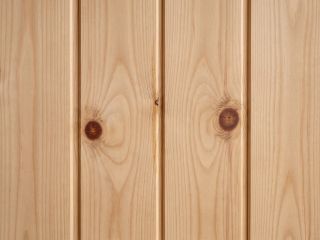 Natural knots and colour variation belong to the wood: sharply bounded and following the grain. AI-generated illustration.
-
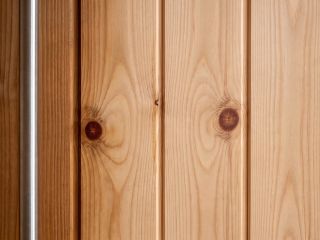 Heat darkening: an even, gradual browning of boards near the heater, with a smooth and intact surface. AI-generated illustration.
-
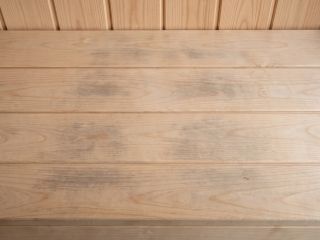 Sweat and water marks: flat grey-brown patches where people sit, often with a sour smell just after heating. AI-generated illustration.
-
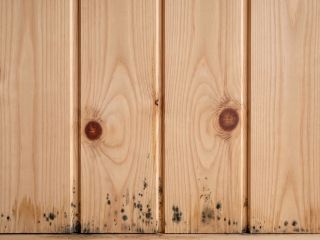 Possible mould: soft, fuzzy dark spots in a hard-to-dry corner near the floor. Appearance alone does not confirm it; smell, spread and location must also fit. AI-generated illustration.


Why it appears
The causes are variations on one theme — moisture trapped in the room:[1]
- Leaving the sauna closed up with session moisture still inside, instead of airing it out.
- Poor or blocked ventilation, so humid air has nowhere to escape — a particular risk in outdoor cabins whose vents clog with leaves or insects.
- Wet towels or covers left sitting on benches, holding moisture against the wood.
- Humid climates or rainy seasons, where background damp hangs around longer.
- Infrequent use, where a single damp session sits in the wood for weeks.
Service technicians add that musty cabins are usually damp rather than dirty: wiping alone never compensates for a cabin that cannot breathe between uses.[2] Structural contributors — roof or flashing leaks, groundwater wicking, missing or damaged vapour barriers, failed waterproofing — produce the recurrent cases that survive repeated scrubbing (see Water leakage and Condensation).
Health and use
Mouldy rooms should be taken seriously but without alarmism. Mould and its spores can aggravate allergies and irritate airways, and people with asthma, mould allergy or weakened immunity are more sensitive; such users should avoid mouldy cabins and the dust raised by remediation until the room is clean, dry and odour-free. Keep the framing general: this page does not diagnose illness, and persistent health complaints belong to a clinician, not to a cleaning routine. The microbiology background is covered in Microbiology of a sauna; barefoot-area fungi are covered in Athlete's foot.
Removal
Work on a cool, ventilated sauna, wearing gloves and a dust mask, and keep susceptible people out of the room during remediation:
- Ventilate the room and let it dry as far as possible first; remove textiles and lift duckboards.
- Spray undiluted white vinegar directly onto the affected wood, leave it for 15–30 minutes, scrub with a stiff brush, rinse with clean warm water and dry completely.[3]
- Where growth has gone below the surface, sand down a millimetre or two of the affected area and reapply vinegar before final drying.[3]
- For affected bench areas, light sanding with fine paper (around 120-grit is commonly cited) followed by a sauna-safe wood treatment restores the surface; never use standard sealers inside the hot room.[4]
- Run the heater to drive off residual moisture, with vents open and the door ajar, then confirm the room dries fully (see Drying a sauna).
Do not use bleach or chlorinated disinfectants on hot-room wood: they lighten and weaken the fibres and leave residues that fume in heat. The lasting fix for mould is airflow, not chemistry — intake low, exhaust high, door open after sessions — and surface treatment only buys time until ventilation is repaired.[3]
Preventing recurrence

- Air the room at least 30 minutes after every session with the door open and vents clear; prop duckboards so air reaches beneath them.[4]
- Remove all damp textiles, empty and dry the bucket, and wipe standing droplets.
- Keep the heater drying cycle: roughly 10 minutes after bathing for daily drying, at least half an hour after wet cleaning.[5]
- Vacuum under benches regularly so dust and spores cannot accumulate in dead-air pockets.
- Keep user hygiene barriers — showering, seat towels, water only on stones — so organic load stays low.
- In humid seasons or little-used cabins, schedule extra drying heats so one damp session never sits for weeks.
Where mould returns within days to the same boards, or appears behind panelling with a persistent musty smell, suspect hidden moisture: failed foil vapour barrier, soaked insulation or an active leak. Such sections may need professional opening, insulation replacement and resealing before re-panelling rather than another round of scrubbing. Log recurrence, locations and remedies in the maintenance schedule and feed structural findings into the risk assessment.
See also
- Condensation in a sauna
- Drying a sauna
- Ventilating a sauna after use
- Odour removal in a sauna
- Disinfecting a sauna
- Water leakage in a sauna
References
- ↑ 1.0 1.1 1.2 Steam & Sauna Experts, How To Remove Mold In Sauna And Stop It From Coming Back?, 8 January 2026. Distinguishes heat stains, water marks and knots from true mould.
- ↑ Epic Hot Tubs, Sauna Maintenance 101: Prevent Mold, Odors, and Wood Damage, 29 July 2026.
- ↑ 3.0 3.1 3.2 The Sauna Place, How to Clean a Sauna Properly: Expert Maintenance Guide. Vinegar dwell method and the ventilation-first principle.
- ↑ 4.0 4.1 SweatDecks, Sauna Not Heating? Common Problems & Fixes, 24 August 2026.
- ↑ Thermory, Sauna Maintenance, 6 November 2024.