




Sauna firewood
Sauna firewood is natural log fuel selected and prepared for a wood-burning sauna stove under that appliance's current instructions and applicable local rules. Suitability depends on fuel form, dimensions, loading, moisture, treatment history, storage and provenance as well as tree species. Both hardwood and softwood may be usable when an identified stove permits them; dry appearance alone does not make reclaimed or contaminated wood acceptable.
Firewood is not used in every sauna, and the term does not encompass all solid biofuels. BS EN 16510-2-10:2025 addresses a defined class of multi-firing sauna stoves fired by natural wood logs. Its published scope excludes mechanically fed, fan-assisted, single-firing heat-storage and water-connected appliances.[1] Fuel instructions for another appliance category cannot be inferred from that title.
Permitted material
The stove manual is the first specification. Narvi's March 2025 instructions for the Black 16, 20, 24 and 20 VS allow natural wood logs and state that hardwood and softwood may be used. They exclude chipboard, fibreboard, briquettes, pellets, painted or impregnated wood, waste and plastic, and prohibit liquid fuel for ignition.[2] These rules apply to those models rather than defining fuel for every sauna heater.
Public guidance supports a similar contamination boundary. The US Environmental Protection Agency lists coated, painted, pressure-treated and glued wood and household waste among materials not to burn.[3] UK guidance also advises against painted, stained or chemically treated timber, furniture, pallets and medium-density fibreboard.[4] Reclaimed appearance cannot reveal adhesives or treatment, and a favourable meter reading does not remove that uncertainty.
Pellets, manufactured logs and briquettes are not interchangeable with split logs. A product may be approved for a particular appliance, but wood content alone does not establish that approval. Fuel form and ignition method must remain within the manual; this article does not supply a substitute list or a firing recipe.
-
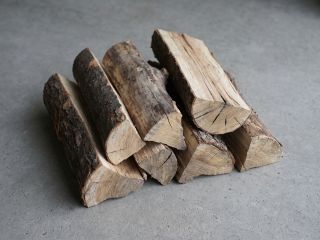 Natural split logs, the fuel form named in the cited stove manual; species alone does not rank quality (AI-generated illustration)
-
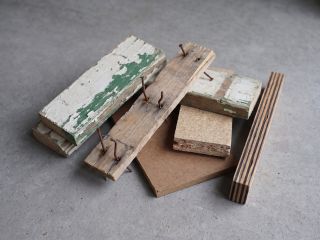 Coated and composite wood offcuts illustrate materials excluded by wood-burning guidance. Appearance alone cannot establish treatment or fuel suitability. (AI-generated illustration)
-
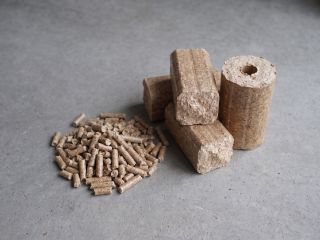 Pellets and briquettes are different fuel forms, usable only where the specific appliance documentation approves them (AI-generated illustration)


Dimensions, loading and species
Piece length, thickness, mass and arrangement affect whether logs fit the firebox and how surface area meets combustion air. They form part of documented operation rather than a general convention. The cited Narvi manual gives stick dimensions, initial and additional loads and an hourly maximum for its own models.[2] Those values demonstrate model specificity and should not be copied to another stove.
Load mass and individual piece size are not interchangeable descriptions. The same mass divided into smaller pieces presents a different exposed area and can change the rate at which volatile gases are released; packing also changes paths for combustion air. For that reason, an owner's manual may control dimensions and sequence as well as total mass. A loosely described “full firebox” has no transferable technical meaning, and adding fuel to accelerate sauna heating can move the appliance outside its documented operation.
Tree species alone does not create a reliable quality hierarchy. Density, resin and bark interact with split geometry, moisture, stove design and firing. Forest Research notes that many hardwoods and softwoods can serve as log fuel when adequately dry.[5] That general biomass guidance is not a sauna ranking.
Direct sauna-stove experiments compared birch, spruce, pine and alder in selected tests and also considered bark, but several comparisons were unreplicated and tied to particular appliances.[6] Experiments on four cordwood and four pellet residential heaters likewise found that species and moisture effects differed with appliance category and fuel form.[7] The latter study was not conducted in saunas; it argues against a universal “best sauna wood” rather than supplying one.
Moisture and measurement
Water in a log absorbs energy while warming and evaporating and can alter the timing and conditions of combustion. Numerical requirements can arise from different sources. Narvi specifies fuel below 20 per cent moisture for the named Black models.[2] England's Ready to Burn rules use a maximum of 20 per cent for firewood sold in quantities below two cubic metres.[8] One is a model instruction and the other a defined sales regime; neither becomes a worldwide stove threshold.
A percentage also needs a basis and method. ISO 18134-1:2022 reports as-received solid-biofuel moisture on a total-mass, or wet, basis.[9] Much wood-science literature instead uses oven-dry wood mass as the denominator.[10] Those numbers are not directly interchangeable.
Representativeness is separate from instrument precision. ISO 18135:2017 covers sampling of deliveries, stocks, roundwood and large pieces; it remained published but had entered the “to be revised” stage by 4 September 2026.[11] A single outer-surface reading cannot characterise a stack. EPA's practical screen—split a log and probe the newly exposed face as the meter maker directs—is not an ISO reference test.[3] Detailed sampling and uncertainty belong under Moisture content of firewood.
Storage and provenance

Storage aims to limit precipitation and ground wetting while allowing ventilation. EPA guidance recommends stacking outdoors off the ground, covering the top and leaving the sides open.[3] Drying time cannot be universal: public examples differ, and climate, species and split size influence the outcome. Age, colour, cracks and sound are therefore indicators rather than measurement.
A sauna wood rack or firewood basket must not encroach upon the appliance's safety distances. Indoor convenience does not override the documented fire-safe arrangement. Stocks should also retain enough identity to distinguish known natural logs from uncertain reclaimed material.
Firewood can transport insects, eggs and fungal material. The Canadian Food Inspection Agency restricts movement from specified regulated areas and advises local acquisition for national parks while checking additional controls.[12] This is Canadian phytosanitary guidance, not a worldwide distance rule or a claim that local wood produces more heat. Temporary wildfire restrictions and smoke-control rules can separately affect whether otherwise manual-approved fuel may be burned at a particular place and time.
Provenance thus answers more than the botanical question. It can establish whether wood was chemically treated, moved through a regulated pest area or sold under a fuel scheme. None of those facts can reliably be reconstructed from bark, smell or flame appearance after purchase.
Combustion evidence
Fuel moisture does not move every emission endpoint in one direction. In the Tissari sauna-stove campaign, the main fuel was birch at about 11 per cent moisture; two stoves were also tested at about 18 per cent. The moister fuel lengthened combustion and lowered measured flue and room temperatures. Carbon monoxide and particle number increased, whereas PM1 mass, polycyclic aromatic hydrocarbons and black carbon decreased in those two comparisons.[6] This is not a general dose–response curve.
A beech-fuel experiment in one domestic stove likewise found that moisture changed both the quantity and properties of emissions.[13] The non-sauna result supports moisture as an operating variable but cannot set a sauna limit. Detailed interpretation belongs to Particulate emissions from sauna stoves, Particulate matter from wood burning and Carbon monoxide in a sauna.
Dry fuel alone cannot ensure low emissions. Load, air setting, stove design and condition of the flue and chimney remain relevant. A spark arrestor cannot make prohibited fuel acceptable or filter fine particles. Outdoor effects are treated under Wood smoke from saunas and Smoke nuisance from a sauna.
Residues
Combustion leaves ash and sometimes char. Their colour and amount from one firing do not provide a complete combustion diagnosis. Removal and cooling belong under Sauna ash management, while the final local route is covered by Disposing of sauna ash. Fuel selection, firing, sweeping and residue handling are related but distinct operations in a wood-burning sauna.
References
- ↑ British Standards Institution, BS EN 16510-2-10:2025, Residential solid fuel burning appliances — Part 2-10: Multi-firing sauna stoves fired by natural wood logs, published 30 September 2025, https://knowledge.bsigroup.com/products/residential-solid-fuel-burning-appliances-multi-firing-sauna-stoves-fired-by-natural-wood-logs, accessed 4 September 2026.
- ↑ 2.0 2.1 2.2 Narvi Oy, Narvi Black 16 / 20 / 24 / 20 VS: Installation and instruction manual, version 03/2025, sections 4.1–4.4, https://narvi.fi/mediatiedostot/manual-narvi-black/, accessed 4 September 2026.
- ↑ 3.0 3.1 3.2 US Environmental Protection Agency, “Best Wood-Burning Practices”, historic Burn Wise record last updated 3 November 2025, https://www.epa.gov/burnwise/best-wood-burning-practices, accessed 4 September 2026.
- ↑ UK Department for Environment, Food & Rural Affairs, “Burn Better, Breathe Better”, https://uk-air.defra.gov.uk/library/burnbetter/, accessed 4 September 2026.
- ↑ Forest Research, “Installing a biomass system”, section “Log stoves”, https://www.forestresearch.gov.uk/tools-and-resources/fthr/biomass-energy-resources/combustion-equipment/installing-a-biomass-system/, accessed 4 September 2026.
- ↑ 6.0 6.1 Jarkko Tissari, Sampsa Väätäinen, Jani Leskinen, Mikko Savolahti, Heikki Lamberg, Miika Kortelainen, Niko Karvosenoja and Olli Sippula, “Fine Particle Emissions from Sauna Stoves: Effects of Combustion Appliance and Fuel, and Implications for the Finnish Emission Inventory”, Atmosphere, volume 10, issue 12, 2019, article 775. doi:10.3390/atmos10120775.
- ↑ Barbara Morin, George Allen, Arthur Marin, Lisa Rector and Mahdi Ahmadi, “Impacts of wood species and moisture content on emissions from residential wood heaters”, Journal of the Air & Waste Management Association, volume 72, issue 7, 2022, pp. 647–661. doi:10.1080/10962247.2022.2056660.
- ↑ UK Department for Environment, Food & Rural Affairs, “Selling wood for domestic use in England”, published 16 February 2021, updated 7 July 2022, https://www.gov.uk/guidance/selling-wood-for-domestic-use-in-england, accessed 4 September 2026.
- ↑ International Organization for Standardization, ISO 18134-1:2022, Solid biofuels — Determination of moisture content — Part 1: Reference method, second edition, August 2022, https://www.iso.org/standard/83191.html, accessed 4 September 2026.
- ↑ USDA Forest Products Laboratory, Wood Handbook: Wood as an Engineering Material, General Technical Report FPL-GTR-282, 2021, chapter 4, https://www.fpl.fs.usda.gov/documnts/fplgtr/fplgtr282/fpl_gtr282.pdf, accessed 4 September 2026.
- ↑ International Organization for Standardization, ISO 18135:2017, Solid biofuels — Sampling, first edition, confirmed 2022 and at “to be revised” stage since 30 June 2026, https://www.iso.org/standard/66481.html, accessed 4 September 2026.
- ↑ Canadian Food Inspection Agency, “Hazards of moving firewood”, modified 9 June 2026, https://inspection.canada.ca/en/plant-health/forestry/hazards-moving-firewood, accessed 4 September 2026.
- ↑ Andrew Price-Allison, Patrick E. Mason, Jenny M. Jones, Eric K. Barimah, Gin Jose, Aaron E. Brown, Andrew B. Ross and Alan Williams, “The Impact of Fuelwood Moisture Content on the Emission of Gaseous and Particulate Pollutants from a Wood Stove”, Combustion Science and Technology, volume 195, issue 1, 2023, pp. 133–152. doi:10.1080/00102202.2021.1938559.