




Sauna programme
Sauna programme is the published timetable of guided sessions and other activities at a sauna or wellness facility. It tells visitors what is happening, where to go, when a session starts and how to join. A programme may combine aufguss infusions, quiet sessions, performances, steam-room rituals and activities in relaxation areas.
The public timetable serves a different purpose from an individual's bathing routine or the staff's operational running sheet. Visitors choose activities from the programme; staff coordinate the rooms, equipment and people needed to deliver them. Sauna programming covers that wider operational work.
Session formats
Programmes commonly distinguish activities by their format:
- Classic infusion: water applications and towel or fan movements are the main elements of a classic aufguss.
- Quiet or meditative session: the description emphasises atmosphere, restrained movement or limited speech. Music and scents may still be used, so a quiet label does not necessarily mean silence or fragrance-free bathing.
- Themed or show infusion: a story, music, lighting or performance accompanies the infusion. Themed aufguss and Sauna theatre describe these formats in more detail.
- Related activities: guided relaxation, sound sessions or scrubs may appear on the same timetable even when they take place outside a sauna cabin.
For example, Thermen Bussloo describes traditional, relaxing, intense and show infusions, together with separate retreat activities. Some activities are included in admission, while others are paid additions.[1] These are programme descriptions rather than internationally standardised categories. A format name alone does not establish temperature or intensity.
Reading the programme
A useful listing brings together several kinds of information:
- Timing: the day, start time, expected duration and any separate check-in or admission time.
- Location: the named room, building or floor, including whether it is in a swimwear or textile-free area.
- Experience: a brief description, the venue's intensity label, and relevant information about scents, music or lighting effects.
- Admission: whether participation is included, paid, reserved, ticketed or first come, first served.
- Participation conditions: age restrictions, accessibility arrangements, language and any equipment or preparation required.
Room temperature, session length and an intensity symbol describe different things. A label such as relaxing describes the intended experience; it does not guarantee that every visitor will find the heat mild. Likewise, a scheduled finish is an event time, not a personal exposure target. Sauna session duration discusses individual timing separately.
Example day programme
This fictional programme offers three optional sessions. Times, rooms, scents and admission arrangements are illustrative.
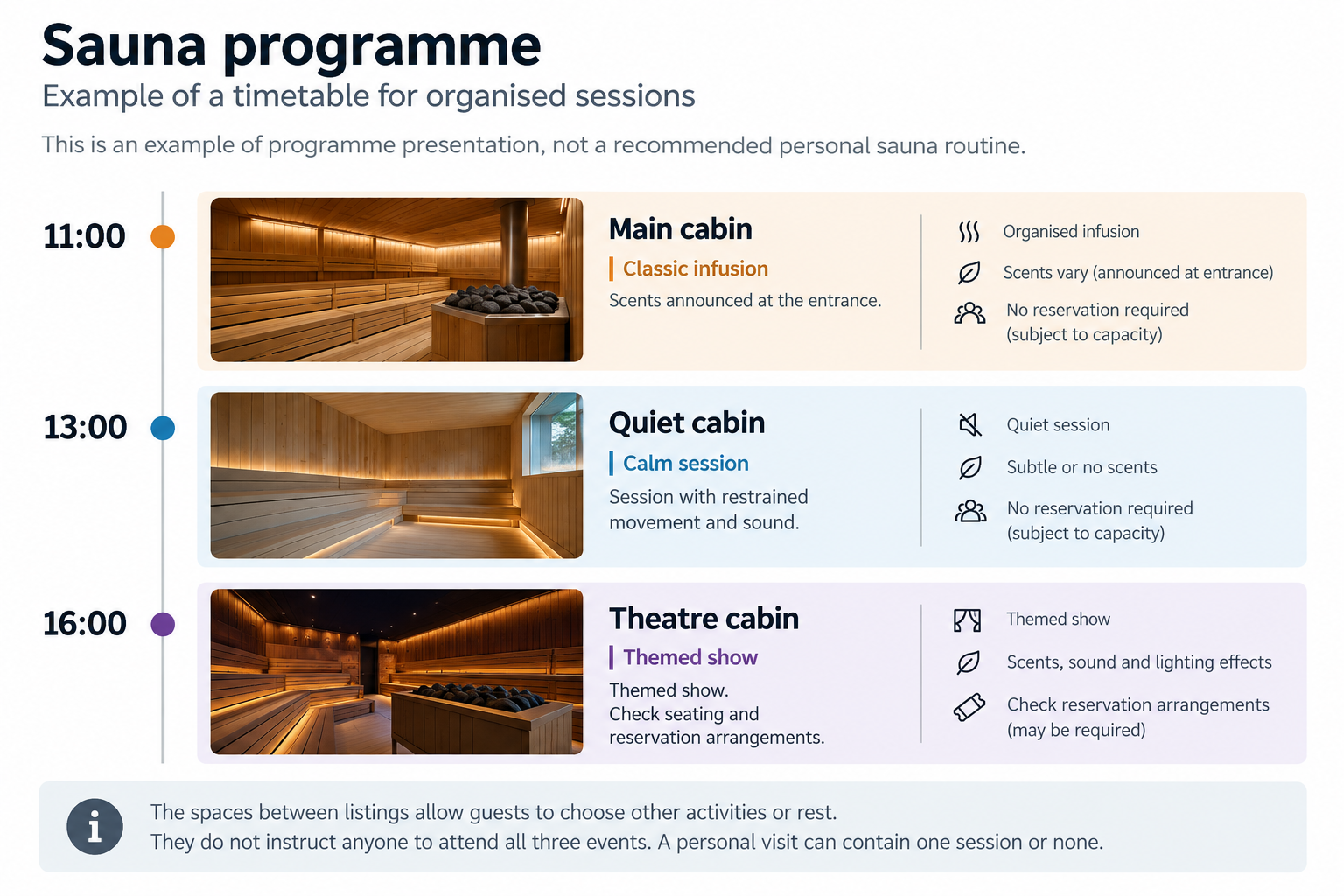

- 11:00 — Main cabin: classic infusion. An organised infusion, with scents announced at the entrance. In this example, no reservation is required; admission is subject to capacity.
- 13:00 — Quiet cabin: calm session. Restrained movement and sound, with subtle or no scents. In this example, no reservation is required; admission is subject to capacity.
- 16:00 — Theatre cabin: themed show. A show using scents, sound and lighting effects. Check seating and reservation arrangements; a reservation may be required.
The intervals allow guests to choose other activities or rest. Visitors may attend one session or none; the example does not prescribe a personal sauna routine.
Larger programmes can offer choices at the same time. For example, The Well's Monday programme, consulted on 19 October 2026, lists a sound bath and a separate Rhassoul ritual at 15:00, each requiring registration and an additional payment. Its published notes require registration for designated activities at least ten minutes beforehand.[2] Simultaneous listings are alternatives, rather than consecutive steps in a single bathing routine.
Capacity and admission
Admission to a facility and admission to a particular session are separate arrangements. An activity included in the entry price can still have limited places. The listing should explain how those places are allocated and where guests wait without obstructing circulation.
Capacity can also change with the activity in the same room. Thermea Spa Village Whitby states that its Logga sauna accommodates up to 90 guests for aufguss and up to 55 for its branch-based Discovery Arboreal ritual. Its listed Village Rituals are included in admission and use a first-come, first-served system rather than advance session reservations.[3] These figures describe that venue's arrangements; they are not occupancy limits for other saunas.
The working area, usable benches and access route need to suit the particular session. Extra demand does not create extra seating or justify filling the space needed by the session leader. See Maximum sauna occupancy for the assessment of room limits.
Preparation and turnover
A session occupies a room for more than its advertised performance time. Planning also accounts for equipment preparation, guest admission, departure, removal of props, cleaning and checks before the next group enters. Staff availability and the readiness of neighbouring cooling and rest areas also affect what a timetable can deliver.
The 2026 Aufguss-WM competition rules provide a concrete example of this distinction: a show lasts 12–15 minutes, while preparation and cleaning have separate allowances of up to 15 and 10 minutes respectively. The rules also require entrances and exits to remain accessible.[4] These competition timings are not a compulsory changeover formula for everyday facilities. The interval between public sessions needs to reflect the actual room, activity and operating procedures.
Changes and visitor choice
Programmes need a clear date and a way to communicate substitutions, cancellations and room changes. Therme Erding, for example, publishes a changing programme and explicitly reserves the possibility of alterations; Thermae Grimbergen directs visitors to its on-site screens for the current schedule.[5][6] A replacement should identify material differences such as a new location, scent or session format.
Guests remain free to leave before an activity finishes. Re-entry rules can differ: Whitby explicitly permits leaving a ritual at any time but does not permit re-entry afterwards.[3] A timetable offers choices across the day; it does not set a required number of heat sessions or a compulsory cooling sequence.
See also
References
- ↑ Thermen Bussloo. Experience programme. Operator description of its own activities and admission arrangements. Accessed 19 October 2026.
- ↑ The Well. Weekly Sauna Program, Monday listings and registration notes. Accessed 19 October 2026.
- ↑ 3.0 3.1 Thermea Spa Village Whitby. Village Rituals, frequently asked questions on admission, capacity and leaving a session. Accessed 19 October 2026.
- ↑ Aufguss-WM. Official Rules AUFGUSS-WM 2026, 3 February 2026, sections on performance time, equipment and access. Competition-specific provisions. Accessed 19 October 2026.
- ↑ Therme Erding. Tages- und Aufgussprogramm, programme notes. Accessed 19 October 2026.
- ↑ Thermae Grimbergen. Wellness programme, schedule-change notice. Accessed 19 October 2026.