




Colour lighting in a sauna
Colour lighting in a sauna is lighting whose spectral output, chromaticity, brightness or sequence can be varied in a sauna room. Its ordinary purposes include changing the visual atmosphere, identifying a programmed scene and coordinating the appearance of an interior. The light's optical colour is independent of the room's thermal state: red light does not raise the air temperature, and blue light does not lower it.
The subject is one part of Sauna lighting. It is distinct from the therapeutic propositions associated with a Colour therapy sauna, and a user's preference for a colour is not evidence of a predictable emotional or medical effect. General illumination, concealed distribution and individual fittings are covered separately by Indirect sauna lighting and Sauna lamp.
Colour, brightness and time
A colour-light system alters the spectrum reaching the eye and the room surfaces. Chromaticity describes aspects of perceived colour independently of brightness. Illuminance concerns light arriving at a surface, whereas luminance concerns light travelling in a particular direction from a source or reflecting surface. These quantities describe different features and cannot be replaced by the name of a colour scene.
Correlated colour temperature (CCT) is principally a descriptor for approximately white light whose chromaticity is sufficiently close to that of Planckian radiation. CIE TN 013:2022 cautions against applying temperature terminology to sources far from that locus.[1] Saturated red, green or blue output is therefore better specified by colour or chromaticity than by an inappropriate kelvin value.
CIE S 026/E:2018 defines quantities for measuring stimulation of five retinal photoreceptor types. Its scope expressly excludes prediction of an application outcome, light treatment, flicker and photobiological safety.[2] A retinal metric alone consequently cannot show that a scene induces sleep, alertness or recovery.
Output may also vary over time. CIE TN 006:2016 distinguishes temporal light modulation, a measurable change in intensity or spectrum, from flicker as a perceptual effect.[3] A slow colour transition is time-varying output but need not be seen as flicker; waveform, frequency, brightness and viewing conditions remain relevant.
A scene name is not a calibrated quantity. Two controls can both label an output “blue” while producing different spectra, brightness and temporal behaviour, and dimming can change the result of some light engines. A reproducible specification therefore records measurable output and operating state rather than relying on a menu label or photograph.
System and room interaction

An installation can comprise light engines or luminaires, drivers, power supplies, controllers, interfaces and signal links. Channels may be combined into fixed colours, nominal white settings, dimming levels or programmed sequences. Suitability of a controller does not establish that every connected fitting, cable or driver can tolerate the same heat and moisture.
Harvia's PRO-DMX is a bounded commercial example. Its current product page describes two colour-light groups, separate or joint operation, seven colours, seven brightness levels and a seven-speed colour changer.[4] Those are the manufacturer's specifications for that model, not a definition of colour-light systems or proof that unspecified connected equipment is sauna-suitable.
Surface reflectance and source position affect the scene seen by an occupant. Timber, stone and glass need not reproduce a source display in the same way, and a change of spectrum can alter visual contrast without changing a surface's temperature. Geometry developed through Sauna design determines sight lines, shadows and direct or reflected glare. Concealing emitters can reduce direct view but does not, by itself, eliminate glare or make distribution uniform.
Environmental exposure also varies within a room. Height, proximity to the heater, enclosures and ventilation can produce different local conditions. Electronics behind a bench may therefore face a different exposure from controls outside the hot room. Product evidence has to match the actual location; neither RGB nor LED is an environmental rating.
Controls may store or recall scenes, but operation is a separate human-factors issue. Labels, feedback, doors, steps, heater guards and controls should remain distinguishable as scenes change. That interface connects colour-lighting decisions with construction and other sensory design, without giving the disciplines a common performance measure.
Perception and evidence
Research on colour and emotion does not support a deterministic hue-to-mood chart. Jonauskaite and Mohr's systematic review covered 132 articles published over 128 years and distinguished emotional associations with colours from emotions actually induced by viewing them.[5] Tasks, cultures and experimental methods differed across the literature.
Kong and colleagues reviewed 64 studies of ordinary indoor lighting published between 1973 and July 2022. They found no consensus on the significance or direction of reported effects on subjective impressions and mood, and identified individual differences, simulated settings, study design and sample size as recurring limitations.[6] Those studies did not test saturated scenes during sauna heat exposure.
No controlled sauna-specific study was retained. Describing a scene as preferred or calming is consequently an account of experience, not evidence of detoxification, weight loss, treatment or a reproducible physiological response. A sound programme may accompany a light scene, but synchronisation does not convert a marketing claim into clinical evidence.
Product safety and installation
IEC 60598-1:2024 sets general safety requirements and tests for luminaires within its scope.[7] General conformity does not approve every sauna position. IEC 60364-7-703 addresses electrical installations in site-built rooms and cabins containing sauna heaters and conditionally excludes prefabricated cabins conforming to an applicable equipment standard.[8] Its project effect depends on national adoption and on the product or installation concerned.
An IP code classifies stated enclosure protection against access, solid objects and water; it does not give an allowable ambient temperature.[9] The luminaire, driver, connections, controls and electrical installation each require evidence appropriate to their position.
IEC 62471-7:2023 provides a photobiological-safety assessment framework primarily for light sources and luminaires emitting visible radiation from 380 to 780 nm.[10] Its listed stability date was 2026, and no published successor was identified at the review cut-off. This is a product-safety framework, not therapeutic validation or sauna approval.
An EU scientific opinion found no evidence of direct adverse effects from LEDs in normal use for the general healthy population, while recording uncertainties about circadian effects, wavelength dose–response, susceptible groups and temporal modulation.[11] Its normal-use conclusion neither qualifies a high-temperature installation nor predicts identical responses for all users.
Access, emergency function and maintenance
-
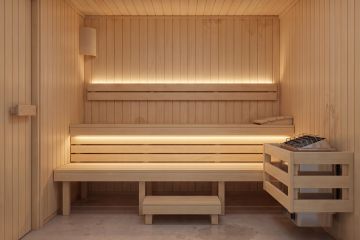 Illustrative low warm-white scene from the common room, with the wall lamp off and only concealed profiles on (AI-generated illustration).
-
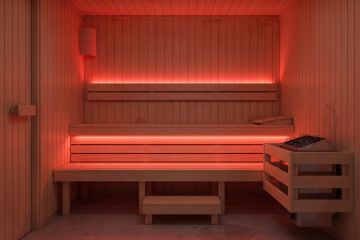 Illustrative saturated red scene using the same room and camera; no equal-brightness or perceptual-performance claim is made (AI-generated illustration).
-
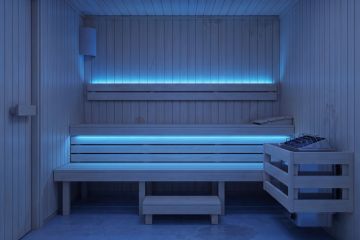 Illustrative saturated blue scene using the same room and camera; no equal-brightness or perceptual-performance claim is made (AI-generated illustration).


Colour should not be the sole carrier of essential information. Visual, textual, tactile or audible feedback may need to be combined in an Accessible sauna, and controls must remain recognisable under every intended scene. Aesthetic preference and functional recognition are separate assessments.
Decorative lighting also cannot be presumed to operate after loss of the normal supply. BS EN 1838:2024 defines luminous requirements for emergency and standby systems where they are required and superseded the 2013 UK edition.[12] Emergency lighting in a sauna therefore needs an independently established supply, function and project basis.
EN 18164:2026 covers design and construction of climated rooms for public use but expressly excludes their electrotechnical aspects.[13] It is not a colour-light wiring standard.
Records should identify component models, locations, environmental limits, scene configuration and the applicable manuals. Unexpected modulation, damaged enclosures, water ingress, heat damage or protective-device operation requires assessment against those documents by the responsible competent discipline. The retained evidence supplies neither a universal replacement interval nor an energy-saving percentage for colour light. Its established function is controlled visual variation, not treatment.
See also
References
- ↑ R. Young, T. Goodman, Y. Ohno and J. Ledig, CIE TN 013:2022, Terms related to Planckian radiation temperature for light sources, International Commission on Illumination, 2022. doi:10.25039/TN.013.2022.
- ↑ International Commission on Illumination, CIE S 026/E:2018, CIE System for Metrology of Optical Radiation for ipRGC-Influenced Responses to Light, 2018, official description. doi:10.25039/S026.2018.
- ↑ International Commission on Illumination, CIE TN 006:2016, Visual Aspects of Time-Modulated Lighting Systems — Definitions and Measurement Models, 2016, official page and PDF, accessed 5 September 2026.
- ↑ Harvia, “Control unit Sentiotec Pro D DMX controller black”, model PRO-DMX, official product page, accessed 5 September 2026.
- ↑ Domicele Jonauskaite and Christine Mohr, “Do we feel colours? A systematic review of 128 years of psychological research linking colours and emotions”, Psychonomic Bulletin & Review, volume 32, issue 4, 2025, pp. 1457–1486. doi:10.3758/s13423-024-02615-z.
- ↑ Zhe Kong, Qilin Liu, Xiang Li, Keming Hou and Qianru Xing, “Indoor lighting effects on subjective impressions and mood states: A critical review”, Building and Environment, volume 224, 2022, article 109591. doi:10.1016/j.buildenv.2022.109591.
- ↑ International Electrotechnical Commission, IEC 60598-1:2024, Luminaires — Part 1: General requirements and tests, edition 10.0, published 6 November 2024, official record, accessed 5 September 2026.
- ↑ International Electrotechnical Commission, IEC 60364-7-703:2004, Electrical installations of buildings — Part 7-703: Requirements for special installations or locations — Rooms and cabins containing sauna heaters, edition 2.0, published 26 October 2004, stability date 2028, official record, accessed 5 September 2026.
- ↑ International Electrotechnical Commission, IEC 60529:1989+AMD1:1999+AMD2:2013 CSV, Degrees of protection provided by enclosures (IP Code), edition 2.2, published 29 August 2013, stability date 2027, official record, accessed 5 September 2026.
- ↑ International Electrotechnical Commission, IEC 62471-7:2023, Photobiological safety of lamps and lamp systems — Part 7: Light sources and luminaires primarily emitting visible radiation, edition 1.0, published 16 February 2023, including corrigenda of June 2023 and September 2024 and interpretation sheet of July 2025, official record, accessed 5 September 2026.
- ↑ Scientific Committee on Health, Environmental and Emerging Risks, Opinion on Potential Risks to Human Health of Light Emitting Diodes (LEDs), European Commission, approved 6 June 2018, official page, accessed 5 September 2026.
- ↑ British Standards Institution, BS EN 1838:2024, Lighting applications — Emergency lighting for buildings, published 31 December 2024, official record, accessed 5 September 2026.
- ↑ European Committee for Standardization, EN 18164:2026, Wellness facilities for public use — Climated rooms — Requirements, approved 26 January 2026; DIN EN 18164:2026-04. doi:10.31030/3677043.