




Open sauna heater
Open sauna heater is a term used in Finnish heater classification for a continuously heated sauna heater whose stone bed and hot air path exchange heat directly with the room, rather than retaining most of the heat behind an insulated lid for later release. “Open” describes thermal coupling and operating pattern. It does not mean an open flame, exposed live parts, or necessarily a stone basket exposed on every side.
The Finnish Sauna Society explicitly calls continuously heated electric heaters open heaters and sets them against insulated, closed heat-storing designs.[1] The same source describes an analogous continuously heated wood-fired class, but English usage is not uniform across manufacturers or countries. The label should therefore be defined rather than inferred from appearance or fuel.
Terminology and operating principle
“Continuously heated” means that heat input can continue or recur while the sauna is in use. An electric appliance may cycle under control instead of remaining at full power. A wood-fired stove may permit further firing during a bathing period without requiring a flame at every moment. The Finnish word kiuas is broader: it denotes a sauna stove or heater without specifying this operating mode.
The functional contrast is a Heat-storage sauna heater, which deliberately charges an insulated stone mass before a later discharge period. An open heater ordinarily warms its stones, room air and room surfaces during the same heating cycle. This distinction also explains the limited overlap with a Closed sauna heater: enclosure is a construction feature, while storage describes how energy is accumulated and released. A metal casing does not by itself make an appliance a storage heater.

Nor must an open heater look like a mesh-sided column. Traditional electric designs may reveal stones mainly at the top; newer products can present a large surface through perforated or partly open casing. All heated stones store some sensible energy, and some open heaters hold a substantial charge. Stone mass alone therefore does not determine the classification.
Electric and wood-fired forms
-
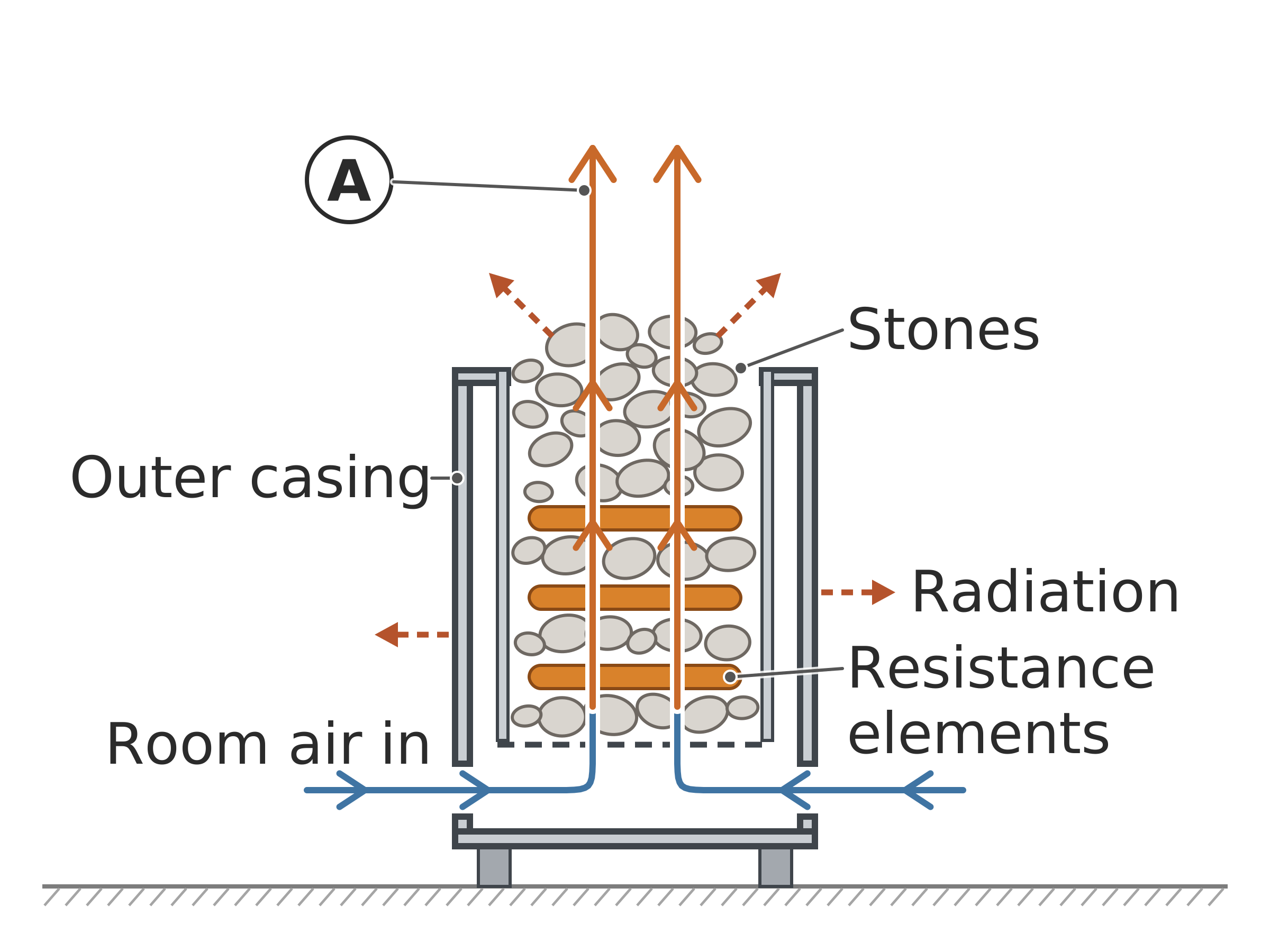 Electric open heater: air warmed by the elements passes through the stone bed into the room during use. Schematic. Key: A: Warm air rising through stones. Notes: Controls: integral or separate unit (model-specific). Schematic, not to scale.
-
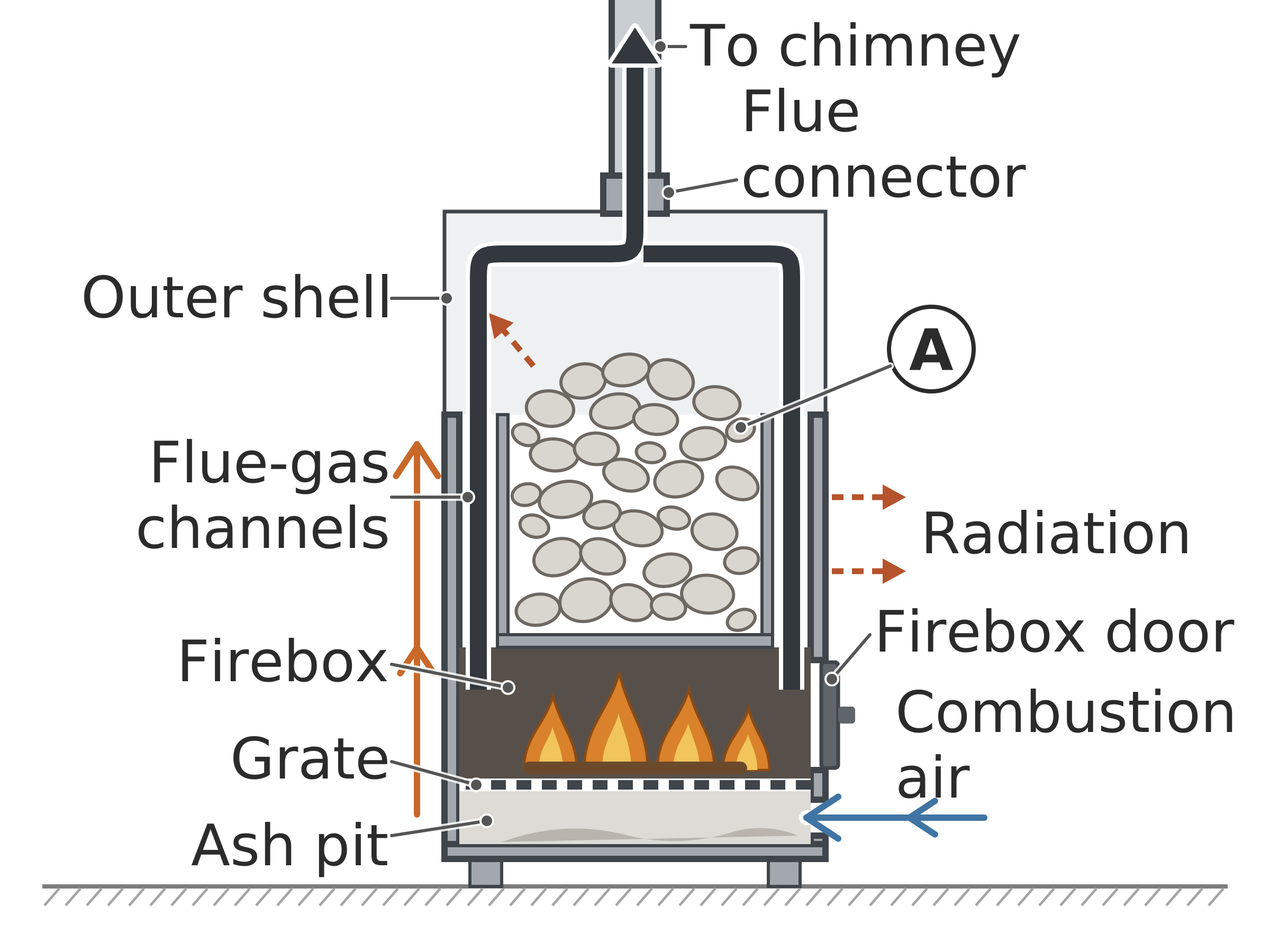 Continuously fired wood stove: gases travel through channels to the flue, separated from the stones on which water is cast. Schematic. Key: A: Stones (heated indirectly). Notes: Schematic, not to scale; firebox and gas path vary by product.


In a conventional Electric sauna heater, resistance elements transfer heat to stones and to air moving through the assembly. The current Harvia Cilindro PC60 record illustrates one geometry with an outer casing partly open at the front and a large exposed stone surface.[2] Its particular casing, stone quantity and water-application claims are product facts, not the definition of every open heater.
The Narvi Saana manual documents another large-stone electric arrangement with a dedicated controller and model-specific stone placement. Its instructions require an open path through the central stone charge while calling for closer placement near the outer edge, illustrating how one heater can require different packing in different zones.[3] Such detail cannot be converted into a general stacking rule.
A continuously heated wood-burning sauna stove uses a different source and heat path. In the Finnish Sauna Society's description, flame and combustion products remain separated from the stones on which bathing water is poured; hot gases travel through designed channels and leave through a flue.[1] The Narvi Kaamos 20 manual identifies that named product as a continuous-burning sauna heater and allows heat to be maintained by further firing within its own limits.[4] Its fuel, draught, fire and flue provisions do not transfer to another stove.
“Open” therefore never authorises smoke or flame in an occupied room. A wood appliance still requires contained combustion and an intact exhaust route. An electric appliance still requires its casing, element supports, sensors and protective devices to be assembled as approved.
Heat transfer and room conditions
Air warmed in and around an open heater becomes buoyant and rises. This plume contributes to room circulation, while radiation from the hot appliance, stones and heated room surfaces provides another transfer path. The result is spatially variable rather than a single uniform temperature: conditions differ with height and with position relative to the heater, air inlet, outlet and cooler surfaces.
VTT experiments in particular mechanically ventilated sauna rooms found that supply- and extract-opening positions affected mixing, vertical temperature distribution and moisture transport after water application.[5] A peer-reviewed computational study by Fan, Holmberg and Heikkinen likewise examined airflow and temperature fields for one room and heater configuration.[6] These configuration-specific studies support the importance of air movement; they do not prescribe one vent arrangement or assign a universal share of heat transfer to convection.
The stone charge is also non-uniform. Proximity to elements or gas channels, contact between stones and local airflow create temperature differences. Compatible Sauna stones and their placement form part of the engineered heat and air path, so the current manual for the appliance takes precedence over generic advice.
Rated output and stored heat are different quantities. Output is a rate of energy delivery, whereas the energy in a stone charge depends on mass, heat capacity and temperature. A high stone load can moderate changes and store more energy under comparable conditions, but may also take more energy to heat. Neither output nor stone mass alone provides a universal sizing rule for rooms with different surfaces, ventilation and use patterns.
Water application
When water reaches permitted hot stones, it is heated and partly evaporated, producing a transient increase in water vapour while withdrawing energy from the stone surface. IAPWS-95 describes the state-dependent thermodynamic properties and vapour–liquid equilibrium underlying this phase change.[7]
It is therefore misleading to say simply that the resulting vapour raises air temperature. Evaporation cools the immediate source, while increased vapour pressure limits evaporation from skin and condensation can transfer latent heat to cooler skin or surfaces. Measurements in one modified, largely sealed electric sauna recorded sharp short-lived humidity and surface-temperature changes after unusually large experimental water doses.[8] That protocol neither defines a normal dose nor ranks open-heater designs.
The event depends on stone temperatures and wettable area, where the water lands, and how the room transports heat and moisture. Manufacturer descriptions such as “gentle” or “sharp” are not comparative evidence unless an exposure and measurement method are defined.
Standards and selection
IEC 60335-2-53 covers specified electric sauna-heating appliances and infrared units. On 4 September 2026, its official catalogue listed consolidated edition 4.2, published 9 March 2021, as the published edition.[9] Proposed edition 5 was then a pre-release Final Draft International Standard in a voting period from 24 July to 4 September 2026, not a final replacement.[10] Neither record defines the Finnish term “open heater” or covers wood combustion.
For wood equipment, EN 16510-2-10:2025 applies to its defined class of multi-firing sauna stoves for natural wood logs, whose stones are indirectly heated and separated from fire and flue gases; it expressly excludes single-firing heat-storage stoves with gases passing through the stones.[11] Within EU construction-product harmonisation, Commission Implementing Decision (EU) 2026/284 records a co-existence period with superseded EN 15821:2010 from 9 February 2026 to 9 February 2027.[12] This regional transition is not a worldwide rule or operating instruction.
A catalogue entry or standard citation does not establish that an installed appliance conforms. Selection must account for the room and intended duty; an electric system also needs a compatible Sauna control unit, while combustion equipment adds fuel, air-supply and flue requirements. Published room ranges, stone amounts and safety distances remain model- and site-specific.
Inspection, safety and evidence limits
Direct thermal coupling does not make the casing or stones safe to touch. Finnish fire-safety guidance says that a sauna should not be used for storage, combustible objects should be absent near the heater before start, stone instructions should be followed, control compatibility should be documented, and electrical installation and repair should be left to qualified professionals.[13]
Inspection includes stone condition and placement, casing, controls and heating elements; a wood-fired installation also includes the firebox, connector and flue. Abnormal control behaviour, deformation, cracking, unusual odour or poor draught calls for stopping use and competent assessment. Service access and intervals belong to the particular manual and maintenance guidance.
Wood-fired models discharge combustion products outdoors through the flue. Experiments across ten conventional Finnish sauna stoves showed that the measured fine-particle and gaseous outputs differed with the appliance, fuel and manner of operation; they did not measure bather exposure or compare electric heaters.[14] Electric operation avoids on-site fuel combustion, but its wider impact depends on electricity supply, controls, losses and use.
Independent matched comparisons of contemporary open and storage heaters remain sparse. The open category alone does not establish faster heating, harsher conditions, lower efficiency, cultural authenticity or a health benefit. Comparison within Sauna technology requires a specified appliance, room, operating cycle and measured outcome.
References
- ↑ 1.0 1.1 Finnish Sauna Society, “Sauna heater”, compiled by Raili Vihavainen from Erkki Helamaa, Kiuas, saunan sydän, Rakennustieto Oy, 1999, https://sauna.fi/en/sauna-knowledge/sauna-heater/, accessed 4 September 2026.
- ↑ Harvia, “Electric heater Harvia Cilindro PC60 6kW 240VAC Steel”, model HPCS6U1HBUL, official product record, https://www.harvia.com/en-US/products/HPCS6U1HBUL/cilindro-pc60-6kw-240vac-steel, accessed 4 September 2026.
- ↑ Narvi Oy, Narvi Saana: Installation and instruction manual, version 04/2026, https://narvi.fi/wp-content/uploads/2026/02/narvi-saana-manual-02042026.pdf, accessed 4 September 2026.
- ↑ Narvi Oy, Narvi Kaamos 20: Installation and operating instructions, version 03/2024, https://narvi.fi/wp-content/uploads/2024/04/narvi-kaamos-08032024.pdf, accessed 4 September 2026.
- ↑ Erkki Äikäs and Rolf Holmberg, Saunan lämpötilat ja ilmanvaihto [Temperature and ventilation of the Finnish sauna], VTT Research Notes 1431, VTT Technical Research Centre of Finland, Espoo, 1992, 40 pp., ISBN 951-38-4325-4, https://cris.vtt.fi/en/publications/saunan-l%C3%A4mp%C3%B6tilat-ja-ilmanvaihto/.
- ↑ Youchen Fan, Rolf Holmberg and Jorma Heikkinen, “CFD simulation on the air flow in a sauna”, Building Research & Information, volume 22, issue 6, 1994, pp. 307–312. doi:10.1080/09613219408727409.
- ↑ International Association for the Properties of Water and Steam, Revised Release on the IAPWS Formulation 1995 for the Thermodynamic Properties of Ordinary Water Substance for General and Scientific Use, IAPWS R6-95(2018), released 21 December 2018, https://iapws.org/technical-guidance/release/IAPWS-95, accessed 4 September 2026.
- ↑ Kristine Nore, Dimitrios Kraniotis and Christoph Brückner, “The Principles of Sauna Physics”, Energy Procedia, volume 78, 2015, pp. 1907–1912. doi:10.1016/j.egypro.2015.11.361.
- ↑ International Electrotechnical Commission, IEC 60335-2-53:2011+AMD1:2017+AMD2:2021 CSV, Household and similar electrical appliances – Safety – Part 2-53: Particular requirements for sauna heating appliances and infrared cabins, edition 4.2, published 9 March 2021, https://webstore.iec.ch/en/publication/68677, accessed 4 September 2026.
- ↑ International Electrotechnical Commission, IEC 60335-2-53:2026 PRV, Household and similar electrical appliances – Safety – Part 2-53: Particular requirements for sauna heating appliances and infrared cabins, proposed edition 5.0, FDIS voting period 24 July–4 September 2026, https://webstore.iec.ch/en/publication/115361, accessed 4 September 2026.
- ↑ British Standards Institution, BS EN 16510-2-10:2025, Residential solid fuel burning appliances – Multi-firing sauna stoves fired by natural wood logs, published 30 September 2025, https://knowledge.bsigroup.com/products/residential-solid-fuel-burning-appliances-multi-firing-sauna-stoves-fired-by-natural-wood-logs, accessed 4 September 2026.
- ↑ European Commission, Commission Implementing Decision (EU) 2026/284 of 6 February 2026 amending Implementing Decision (EU) 2019/451 on harmonised standards for construction products, Official Journal of the European Union, 9 February 2026, http://data.europa.eu/eli/dec_impl/2026/284/oj.
- ↑ Finnish National Rescue Association, “Fire safety of electrical appliances”, produced with Sähköinfo, the Finnish Safety and Chemicals Agency and Finance Finland, https://www.spek.fi/en/safety/fire-safety-of-electrical-appliances/, accessed 4 September 2026.
- ↑ Jarkko Tissari, Sampsa Väätäinen, Jani Leskinen, Mikko Savolahti, Heikki Lamberg, Miika Kortelainen, Niko Karvosenoja and Olli Sippula, “Fine Particle Emissions from Sauna Stoves: Effects of Combustion Appliance and Fuel, and Implications for the Finnish Emission Inventory”, Atmosphere, volume 10, issue 12, 2019, article 775. doi:10.3390/atmos10120775.